

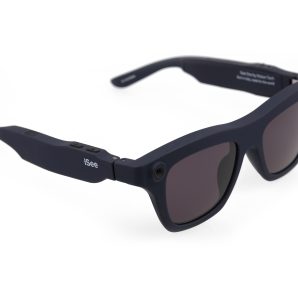
iSee Glasses
The iSee project was created as a social initiative to use technology to aid blind people with mobility outside. To date, technology, when it has been used at all, is deployed mainly to assist the visually disabled indoors. By contrast, for outdoor environments, there has been limited progress, with most sight impaired people relying on traditional options such as guide dogs, white canes and Braille signage.
The iSee glasses solution, which has been developed in conjunction with visually disabled users, uses state-of-the-art technology to complement the current aids available. The iSee glasses uses ultrasonic sensors to detect obstacles at a distance of up to 4m away. By combining data from these sensors on each side of the glasses, both the distance and direction of any obstacle can be detected. AI processing is used to filter the most important information so the users are not overwhelmed with data.
Feedback is provided via audio, which can be in the form of vocal or acoustic alerts, according to the preference of the user. The audio is delivered by open-type MEMS speakers, which provide clear output but without blocking out other sounds from the environment, which is clearly critical for a visually impaired person.
The glasses also include an integrated Bluetooth Low Energy solution, which provides connectivity to a smartphone. This connection supports standard audio functions such as call access, audio playback, and access to digital assistants. It also is used for set up and personal configuration of the glasses via a voice-guided setup, and over the air updates. The response of the glasses can be changed depending on the environment, for example to respond to the degree of background noise.
iVision chose the ISP2053-AX BLE module as the core of the electronics in this solution. This device, based on Nordic Semiconductor nRF5340 chipset, offers a fully integrated RF solution in a miniature form factor, and incorporates a dual core processing solution with separate application and radio cores.
This powerful device allows the ISP2053 to provide the Bluetooth connectivity, and manage and process data from the ultrasound sensors. It also handles the audio connectivity between the smartphone and glasses, and delivers the audio output guiding the user in the environment, driving the MEMS speakers via dedicated analogue to digital convertors.
With all the core computing and radio functions, including antenna, encapsulated within this miniature 8 x 8 mm module, the glasses can remain compact, light, and easy to wear. Low power consumption is another key feature, which enables the glasses to be used for a day of normal usage without recharging.
“We choose Insight SIP’s ISP2053-AX, as it offered a fully integrated solution. The miniature size of the module allowed us to integrate it into the glasses frame without issue. Having all the RF functions provided by the module allowed us to focus on our engineering efforts on the specific issues of the solution” said Federico Fulchir, project manager at IVision.
“We are delighted our device has been chosen for this ground breaking project to assist the visual impaired. It is truly inspiring to see such cases where technology is being used to improve lives in a direct and meaningful way.”
For more news please visit: News – CIE
