
Versinetic warns EV manufacturers to act now ahead of 2026 UK charging standards changes
Expert guide highlights new standards and regulations reshaping EV charging compliance from 2026
Versinetic, is warning UK EV charger manufacturers and charge point operators to act now ahead of significant charging standards changes taking effect in 2026, with downstream implications for organisations responsible for deploying EV charging infrastructure.
According to Versinetic, the convergence of new technical protocols and tougher regulation is raising the minimum technical and regulatory baseline for EV chargers sold or deployed in the UK.
Key developments include the rapid adoption of ISO 15118 (Plug & Charge), which introduces certificate-based authentication and secure charger-to-vehicle communication; migration to Open Charge Point Protocol (OCPP) 2.0.1 and 2.1, raising expectations around cybersecurity, smart charging and interoperability with back-office systems; and compliance with UK-specific regulations such as the Smart Charge Points Regulations and Public Charge Point Regulations, which impose mandatory requirements around smart charging, payments, reliability and data transparency.
Together, these overlapping technical and regulatory requirements are tightening procurement and interoperability expectations across charging networks. Manufacturers that fail to address them risk products stalling at certification, facing costly redesigns, or being excluded from future network procurement as operators and fleets increasingly demand full standards compliance.
In response, Versinetic has published an in-depth guide, “Emerging UK EV Charging Standards: What Manufacturers Need to Know”, designed to help manufacturers translate evolving standards into concrete design, testing and certification decisions.
Unlike high-level standards commentary, the guide is structured around five practical decision areas that directly affect charger roadmaps: standards alignment, compliance and testing, hardware and firmware architecture, operational readiness, and future planning. It is aimed at engineering, product and technical leadership teams responsible for making long-term platform and architecture choices.
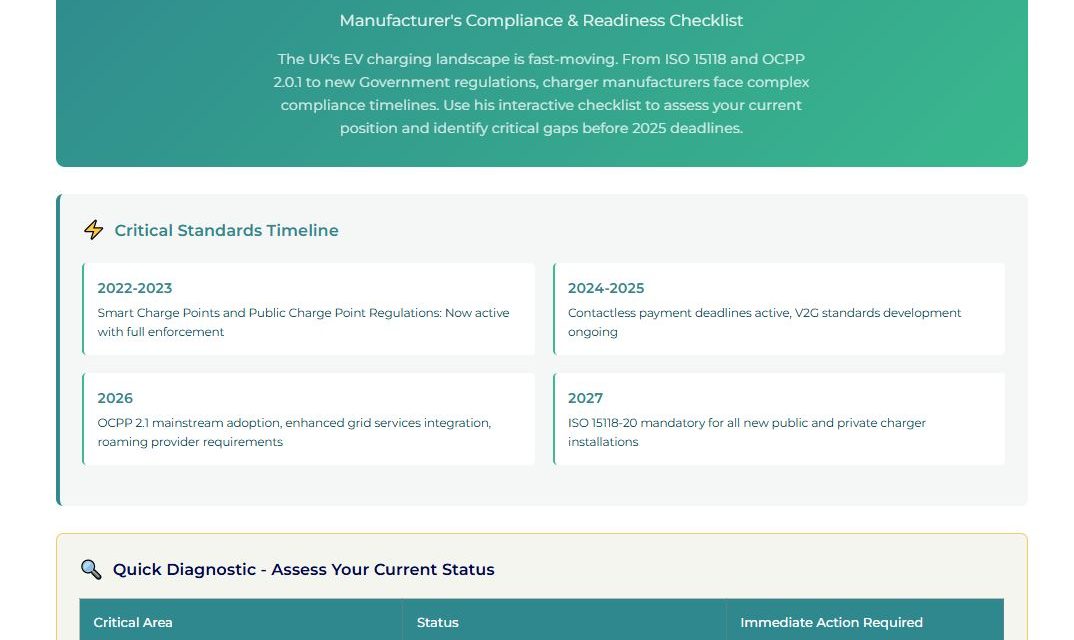
The guide also includes an interactive audit and compliance toolkit that allows manufacturers to assess their current readiness against emerging standards and identify where late design decisions could create certification, retrofit or market-access risk.
Dunstan Power, managing director at Versinetic, said: “UK EV charging standards are increasingly acting as gatekeepers for grid connection, certification, and commercial deployment. What many manufacturers underestimate is when compliance decisions are effectively locked in during the development cycle.
“One of the biggest risks we’re seeing is manufacturers assuming they can retrofit compliance later. In practice, hardware architecture, firmware structure and security choices constrain what can be achieved, and by the time non-compliance becomes visible, the cost and disruption are often far higher than expected.”
Versinetic has delivered ISO 15118 and OCPP integrations across public rapid and destination charging deployments in the UK and Europe, alongside standards and compliance consultancy supporting manufacturers through complex certification and interoperability programmes.
The guide is available at:
https://www.versinetic.com/news-blog/uk-ev-charging-standards-2026/
For more news please visit: News – CIE
