

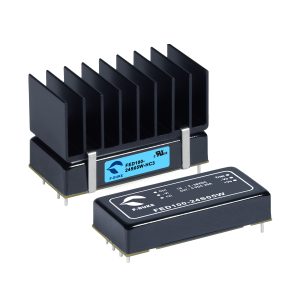
High-Efficiency Compact DC/DC Converters:
LCD50W and FED100W Series
P-DUKE proudly presents the new DC/DC converter series, LCD50W, and FED100W, featuring compact 1”x1” and 2”x1” designs. These converters cater to the rigorous demands of modern technology and electronic systems, offering exceptional power density, efficiency, and reliability.
The LCD50W series delivers up to 50W of output power within its compact 1”x1” industrial standard package. It supports input voltage ranges of 9 to 36 Vdc and 18 to 75 Vdc, providing single and dual outputs of 5, 12, 15, 24, ±12, ±15, and ±24 Vdc.
The FED100W series offers up to 100W of output power in a compact 2”x1” package. It accommodates input voltage ranges from 9 to 36 Vdc and 18 to 75 Vdc, with single outputs of 5, 12, 15, 24, 28, 48, and 54 Vdc.
Both series boast high power densities of up to 238W/in³, making them an ideal space-saving solution for system integration. With a remarkable 94% conversion efficiency, they minimize power loss and heat generation, extending operating temperatures to ease thermal management challenges. Certified to IEC/EN/UL 62368-1 standard and compliant with MIL-STD-810F for shock and vibration, these converters operate at altitudes up to 5000 meters and within ambient temperatures ranging from -40°C to +110°C. Their 4:1 input voltage range makes them perfect for rugged, high-reliability applications such as servo systems, automation control, measurement instruments, and automated inspection equipment.
Features-
■ LCD50W: 50W Output Power
FED100W: 100W Output Power
■ 4:1 Wide Input Range From 9 to 36 and 18 to 75V
■ Output Voltage:
LCD50W: 5, 12, 15, 24, ±12, ±15, and ±24 Vdc
FED100W: 5, 12, 15, 24, 28, 48, and 54 Vdc
■ 5000m Operating Altitude
■ IEC/UL/EN 62368-1 Safety Approval (*pending)
■ 3 Years Product Warranty
Applications-
Servo systems, Automation control, Measurement instrument, and Automated inspection equipment.
Efficient DC/DC Converters for Industrial, Railway and Challenging Environments

The HAE300W series of DC/DC converters from P-DUKE introduces a substantial increase in output power capacity, reaching up to 300W, all within a compact half-brick design. This series is engineered to fulfill the stringent requirements of industrial and railway (rolling stock) applications.
Featuring a 4:1 input voltage range that spans 9 to 36, 18 to 75, and 40 to 160 Vdc, the HAE300W series is versatile for various power systems across different regions. It also offers a broad selection of output voltage options, including 5, 12, 15, 24, 28, 48, and 54 Vdc, with an adjustable output range of +10% to -20% using an external resistor.
Equipped with multiple protective features, the HAE300W series ensures system safety with over-current protection (hiccup mode), output over-voltage protection (hiccup mode), continuous and auto-recovery output short-circuit protection, input under-voltage lockout, output remote sensing, and remote control capabilities. It is certified to comply with industry standards such as IEC/EN/UL62368-1, EN 50155, and EN 45545.
Built to endure harsh environments and demanding conditions in railway and industrial sectors, the HAE300W series meets MIL-STD 810F and EN 61373 standards for vibration and mechanical shock, and is operable at altitudes up to 5000 meters. This makes it an excellent choice for powering electronic devices in rolling stock, offering high reliability and stability.
Features-
■ 300W Output Power
■ 4:1 Wide Input Range: 9-36, 18-75, and 40-160Vdc
■ Output Voltage: 5, 12, 15, 24, 28, 48, and 54Vdc
■ No Minimum Load Required
■ 3000Vac Reinforced Insulation for 110Vin
■ 2250Vdc Basic Insulation for 24 and 48Vin
■ 5000m Operating Altitude
■ EN 50155, IEC/UL/EN 62368-1 Safety Approval (*pending)
■ 3 Years Product Warranty
Applications-
Train Control and Management Systems (TCMS) , Passenger Information Systems , Lighting systems in train cars , Air conditioning and ventilation control units , Robotic arms and industrial robots , Programmable Logic Controllers (PLCs) , and Human-Machine Interfaces (HMIs)
