
As vehicle architecture evolves towards software-defined vehicle (SDV) platforms, the complexity of designing, deploying, and validating these architectures has grown exponentially. To address these challenges, helping to accelerate development cycles and enabling deployments to scale from local ECUs to cloud environment, RTI has integrated AI capabilities into the latest version of Connext Drive.
Whether you are currently working with Connext Drive today or exploring its potential for your future SDV design, RTI is committed to your success. We have been collaborating with several OEMs to accelerate development and simplify the process of bringing SDVs to market. From this experience, we have learned exactly where difficulties lie and what is really needed. The top three takeaways are:
- Integration can be difficult without the right partner.
- “SDV-ready” doesn’t always mean plug-and-play.
- Your engineers don’t need slideware: they need real examples that they can easily run.
RTI application engineers can address all of these challenges by taking the following steps:
Case + Code and market needs assessment
Efficient design begins with several relevant examples from the RTI automotive portfolio, mapped out in the form of a case study and market requirements capture. Each automotive domain, from ADAS to infotainment, requires domain-specific blueprints to ensure consistent design, quality and compliance. As RTI supports various consortia and key standards, such as AUTOSAR, COVESA, OMG DDS™, SOAFEE, and others, our communication software framework can easily interoperate with a large number of blueprints. You can view the full portfolio of Case + Code examples here.
This approach establishes a foundation for scalability, with the ability to feed a variety of critical data into the RTI Connext Chatbot, including:
- Data models
- Network topologies
- Performance budgets
- Quality of Service (QoS) guidelines
Working with a blueprint for your domain can help you to jump-start your initial design and accelerate the initial project phases, which tend to be the most costly.
Our AI Chatbot Functions as Your Engineering Copilot
Developers can now interact with the Connext Chatbot, which has enhanced visualisation capabilities. Plain UML can be used or freehand drawings can be drawn. It’s not just a support tool – think of it as your architectural partner.
The AI chatbot understands the context and can access architectural metadata. Therefore, it can help:
- Generate XML model examples,
- offer configuration recommendations, and
- define QoS settings based on use cases.
The chatbot is context-aware, assisting you with the design and validation of code. This approach saves research time, identifies errors early and helps developers make smarter decisions.
Visual Studio Integration
To bridge the gap between architecture and implementation, the Connext Chatbot integrates with Visual Studio to support:
- Code snippet generation
- Debugging capabilities
- Real-time code checks
This approach reduces integration overheads through model-based generation and CI/CD integration. More advanced Connext Drive users can integrate directly with our standard tooling.
For example, the RTI System Designer tool now includes an experimental AI assistant that is grounded in RTI’s extensive knowledge base. You can now create and modify your systems using natural language, enabling you to ask questions, request changes and receive suggestions for improving your design – all without having to wade through raw XML. Additinally, developers can receive instant feedback on topic mismatches or QoS violations.
We invite you to view the example prompt and code at the end of this blog post.
See It in Action and try the use cases
Try the use cases
The RTI SDV toolchain provides sequential, integrated tools to streamline the development cycle. Explore Case + Code blueprints for use cases ranging from Zonal Architecture to ADAS and beyond.
Chat with Connext AI
See how our AI assistant can help you to model, design, and debug faster for use cases such as simulation. This will help you understand and resolve integration challenges upfront.
Accelerate Success
Learn how Connext Drive with AI can help automotive and mobility teams to work with increaslingly complex software-defined systems and meet tight deadlines. The Connext Drive platform is designed to make that journey dramatically smoother, from proof of concept to full-scale production. By combining built-in intelligence, seamless interoperability and proven architectural patterns, RTI helps OEMs to accelerate development, reduce risk and deliver reliable innovation at scale.
Sample Prompt in Connext AI:
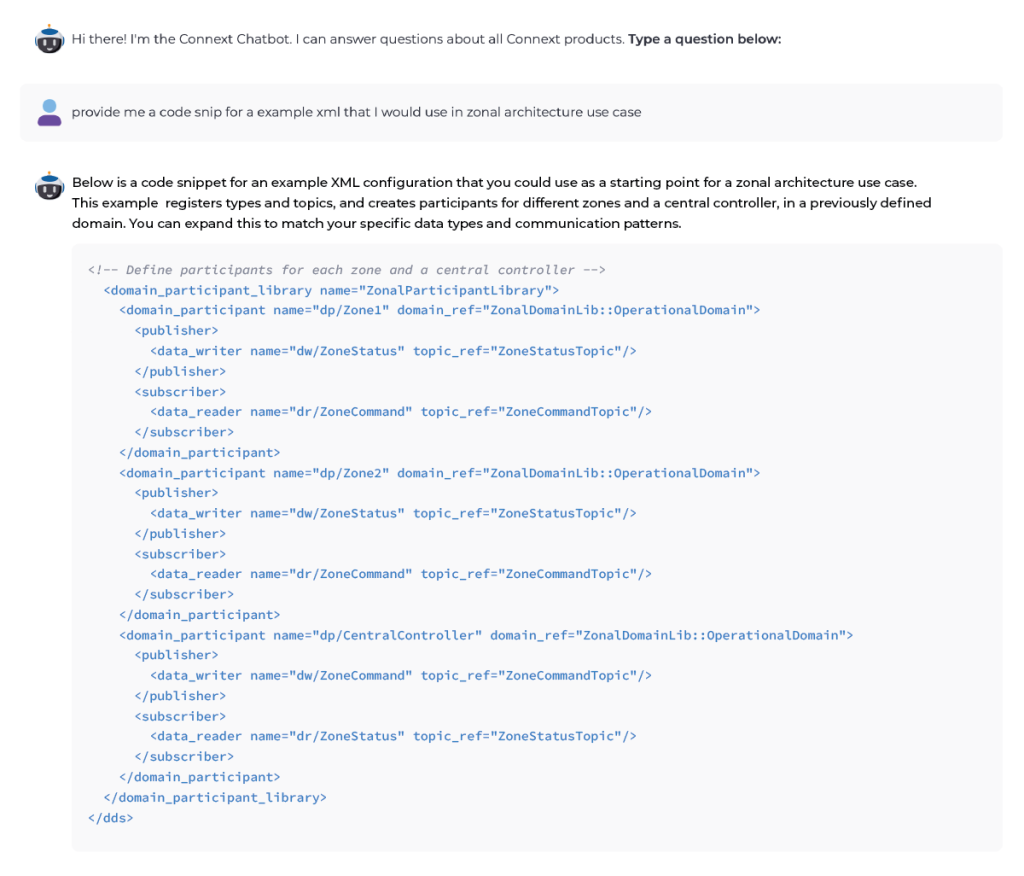
Figure 1: The Connext Chatbot provides sample code for an architectural use case. This XML snippet refers to two types: ZoneStatus, which reports status from each zone, and ZoneCommand, which sends commands to zones. It creates participants for two zones and a central controller. To add more zones, duplicate the ’domain_participant’ block for each new zone. (Source: RTI)
About the Author: Mihai Potoceanu, Senior Product Manager at RTI with over a decade of experience in the automotive industry.