
Compliance, cybersecurity and V2G to drive UK EV charging market change in 2026, Versinetic finds
EV engineering specialists identify cybersecurity, V2G commercialisation, and regulatory enforcement as the defining challenges for charge point operators this year
Versinetic, an electric vehicle (EV) charge point solutions provider, has identified that the UK electric vehicle charging market is entering a period of significant change, driven by regulatory enforcement, growing cybersecurity risk, and the commercial arrival of vehicle-to-grid technology.
Analysing where the EV charging industry is heading in 2026 and beyond, Versinetic sees that the automotive industry is approaching a breaking point where operational and compliance shortcomings will result in significant financial consequences.
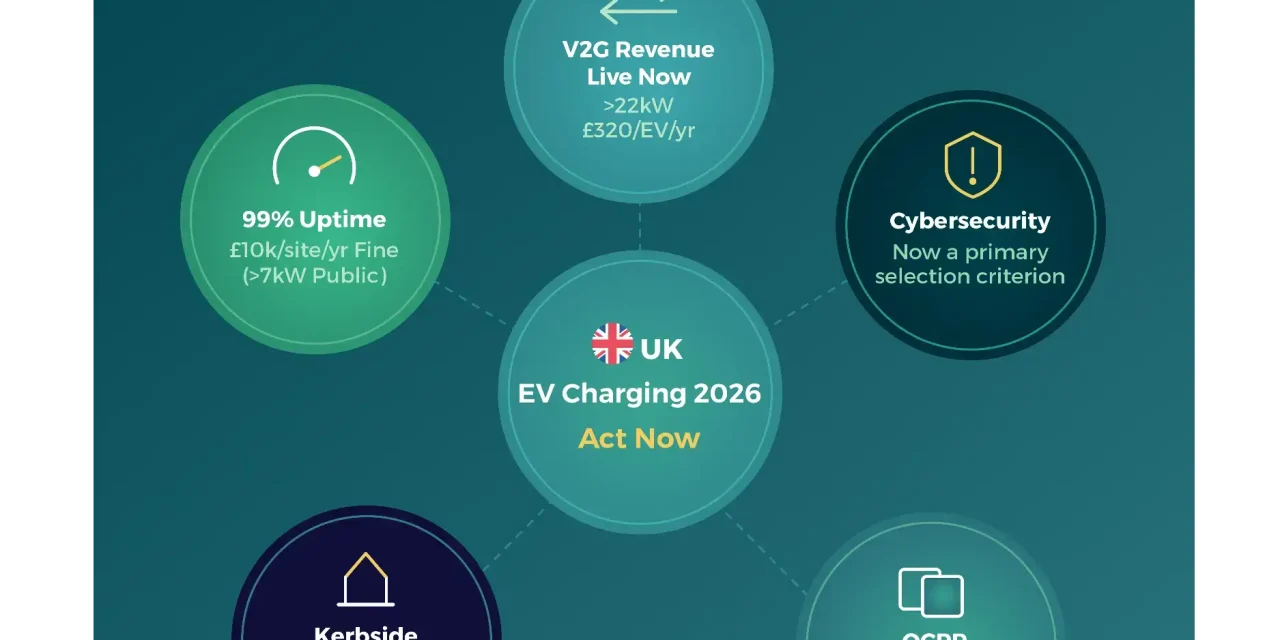
The UK’s legally mandated 99% uptime requirement for rapid chargers is expected to place smaller charge point operators under acute pressure. Enforced by the Office for Product Safety and Standards, it will bring fines of up to £10,000 per non-compliant unit. So, Versinetic anticipates that regional operators lacking the scale for dedicated maintenance teams could face a stark choice between investing in remote monitoring and predictive maintenance or becoming acquisition targets for larger networks.
Alongside regulatory pressure, Versinetic foresees cybersecurity as a fast-emerging factor in hardware procurement. After electric buses were shown to be disabled remotely by their manufacturer, and undisclosed communication devices were found in solar power inverters, Versinetic expects operators to demand full supply chain transparency as a baseline requirement, not a differentiator. The company argues that the same vulnerabilities exist in EV charging hardware, and operators cannot afford to treat this as a future issue.
On a more positive note, Versinetic forecasts that 2026 will mark the commercial breakthrough of vehicle-to-grid (V2G) technology. Bidirectional chargers can now generate over £320 per EV per year through demand-response tariffs, while major manufacturers including Tesla, General Motors, and BMW are scaling V2G-capable vehicles. Versinetic expects the first commercial building installations to start showing real V2G revenue in the second half of 2026.
The global V2G market, valued at around £11.4 billion in 2024, is projected to reach £129.8 billion by 2034. Versinetic brings direct experience through its role in the VIGIL (Vehicle-to-Grid Intelligent Control) project, funded by Innovate UK and BEIS.
Versinetic’s analysis also points to the ongoing failure to address kerbside charging for the estimated 9.3 million UK households without off-street parking as a structural market weakness. With 43% of UK charging devices concentrated in London and the South East, Versinetic warns that the geographic access gap is likely to widen before it narrows, without meaningful policy intervention. The company also noted that solutions capable of reducing installation costs in this segment represent a significant commercial opportunity.
Dunstan Power, Managing Director of Versinetic, commented: “The EV charging market is maturing fast, and 2026 is the year where cutting corners on compliance, cybersecurity, or interoperability will have real commercial consequences. We’re seeing operators face fines for uptime failures, procurement teams demanding supply chain transparency they’ve never asked for before, and V2G moving from a nice-to-have into a genuine revenue stream. The companies that will succeed are those building infrastructure for the market as it actually is, not chasing headline charging speeds that the grid simply cannot support at scale.”
Versinetic’s full analysis is available at: www.versinetic.com/news-blog/ev-charging-infrastructure-2026-trends
For more news please visit: News – CIE
