

Enhancing betting and lottery kiosk performance and security with Edge AI
Executive summary
A betting and lottery operator required an upgrade to its self-service kiosk infrastructure to support higher transaction volumes, improve system stability and enable real-time AI applications at the point of service. The existing platform was not able to deliver the required performance without introducing latency or increasing operational complexity.
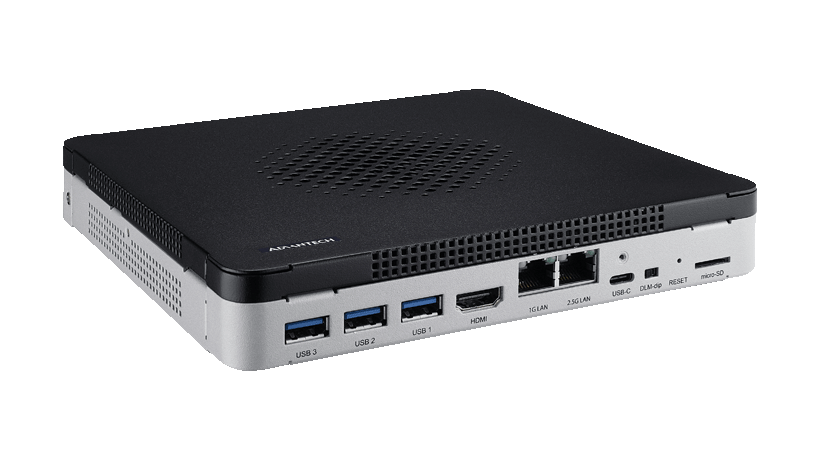
Advantech DS-015 was selected, an ultra-slim edge AI platform powered by NVIDIA Jetson Orin Nano and Jetson Orin NX with Super Mode, delivering up to 157 TOPS for on-device inference and responsive, scalable kiosk operations. This enabled local processing for both transaction workloads and AI inference, while supporting secure deployment and remote management across a distributed kiosk network.
When the odds are against legacy systems
Self-service kiosks in the betting and lottery sector are no longer limited to transaction handling. Systems are increasingly expected to support real-time analytics, user interaction monitoring and enhanced security functions, while maintaining consistent responsiveness.
At the same time, operators must ensure high system availability, meet regulatory requirements and manage large-scale deployments efficiently. These combined demands expose the limitations of legacy platforms that were not designed for AI workloads or continuous remote operation.
The operator experienced performance limitations during peak usage, when high transaction volumes led to slower response times and occasional instability. This directly affected service efficiency and user experience. In parallel, the existing infrastructure lacked sufficient compute capability to support real-time AI applications, as running analytics alongside transaction processing introduced performance trade-offs.
Operational overhead was also a concern, as maintenance, software updates and diagnostics frequently required on-site intervention. This increased both downtime and cost across the kiosk network. Security requirements added further complexity, as kiosks process sensitive financial and personal data and require stronger mechanisms for device authentication and system integrity than the existing platform could provide. All improvements also had to be implemented within the physical constraints of existing kiosk cabinets.
Placing the bet on Edge AI performance
To address these requirements, the operator deployed a compact edge AI system as the standard compute platform across both new and retrofit kiosks. The solution integrates CPU, GPU and AI acceleration capabilities in a single unit, allowing transaction processing and AI inference to be executed locally.
Based on NVIDIA Jetson Orin Nano and Jetson Orin NX modules, the platform delivers up to 157 TOPS (INT8) of AI performance, depending on configuration. This provides sufficient headroom to support multiple concurrent workloads without compromising system responsiveness.
With local processing capability, transaction workflows and AI applications can run in parallel without introducing delays. The system remains consistently responsive during peak periods, reducing queue times and improving overall throughput. Processing data at the edge also reduces reliance on network connectivity, contributing to improved stability and more predictable performance.
AI enablement, remote management and security
The increased compute capacity enables deployment of AI applications directly at the kiosk, including real-time fraud detection and anomaly monitoring, as well as analysis of user behaviour to support operational insight and service optimisation. Where permitted by regulation, vision-based workflows can also be implemented. These applications benefit from the platform’s GPU architecture, which supports efficient parallel processing of multiple inference tasks.
The system also supports remote monitoring and control through Advantech’s SUSI API, allowing operators to manage distributed deployments from a central location. Health monitoring, diagnostics and software updates can be performed without requiring on-site access, which in turns reduces maintenance overhead and improves system availability.
To meet security and compliance requirements, the platform incorporates hardware- and firmware-level protection mechanisms. A Trusted Platform Module is used for secure storage of keys and certificates, while Secure Boot ensures that only authorised software components are executed. In combination with controlled remote update processes, these features support secure deployment in transaction-based environments.
A stronger hand for integration and deployment
The system’s ultra-slim design allows it to be integrated into space-constrained kiosk cabinets without requiring significant modification. Thermal performance is maintained through an optimised cooling approach that supports continuous operation in enclosed environments, while flexible mounting options simplify installation.
Within the kiosk, the edge system operates as the primary compute node, interfacing with display and touch systems, vision devices and standard peripherals such as payment modules, printers and scanners. It also connects to backend infrastructure through secure communication channels, enabling centralised management and data exchange. This establishes a consistent hardware and software baseline across deployments.
The payoff: measurable operational outcomes
Following implementation, the operator achieved more consistent system responsiveness during high-demand periods, alongside the ability to deploy real-time AI applications directly at the edge. Operational efficiency improved through reduced reliance on on-site maintenance, while the overall security baseline was strengthened to better align with transaction processing requirements.
The compact system design also enabled faster and more straightforward deployment across different kiosk formats.
Conclusion
The introduction of edge AI processing within kiosk infrastructure provides a practical approach to addressing performance, security and operational challenges in a single platform. By consolidating compute and AI capability at the edge, operators can maintain responsiveness, reduce dependency on external processing and support the deployment of advanced applications within existing physical constraints.
https://www.advantech.com/en-eu/
For more news please visit: News – CIE
