
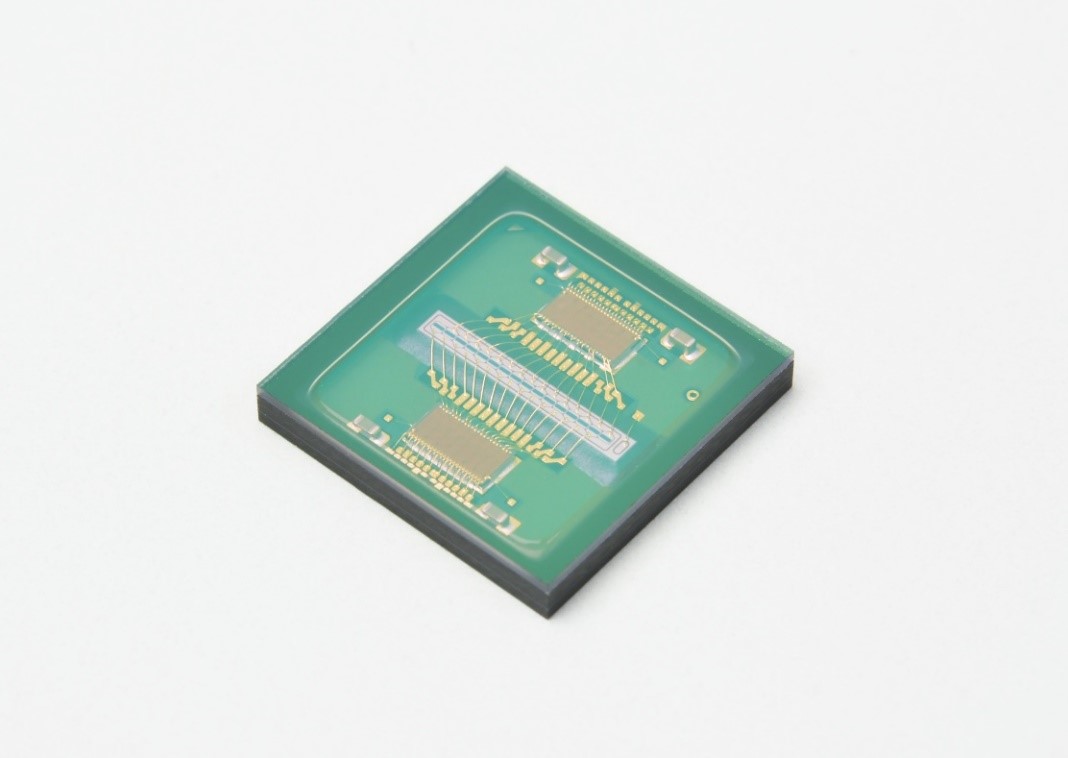
 Called the Gain Stabilized Si APD S16430-01CR, this APD array was integrated with a self-bias generator (SBG)2 by harnessing our unique opto-semiconductor manufacturing technology. Since the SBG stabilizes the optical signal multiplication factor, a microcontroller and temperature sensor are no longer needed to adjust the multiplication factor to match changes in temperature. Additionally, the transimpedance amplifier in the signal processing circuit is built into the same package to further reduce the cost of LiDAR modules for automated guided vehicles. Samples will be available from the end of October, with mass production scheduled to begin in April 2023.
Product Overview
This product is a 16-channel APD array for industrial LiDAR use, integrated into the same package with an SBG and TIA, which is a signal processing circuit for current to voltage conversion.
An APD array has multiple channels formed on the same chip, each of which is capable of multiplying optical signals when a voltage is applied. Compared to ordinary photodiodes, APDs can detect low-level light with higher sensitivity to measure the distance of distant objects, making them the mainstream in optical sensors for LiDAR. However, their multiplication factor or gain needs to be adjusted to match changes in temperature. We have been designing, manufacturing, and marketing easy-to-use APD modules with a built-in microcontroller, temperature sensor, and TIA for adjusting the multiplication factor. To lower the cost of LiDAR modules, we have also been designing and fabricating a new APD array that needs no microcontrollers or temperature sensors.
We built a technology to form an SBG on a semiconductor substrate with high precision and high quality by applying our unique, advanced opto-semiconductor manufacturing technology. This in turn has led to the successful development of a new APD array integrated with an SBG that stabilizes the optical signal multiplication factor even during temperature fluctuations, thus eliminating the need for a microcontroller or temperature sensor. The TIA for the signal processing circuit is simultaneously built into this same package. Using this APD array as an optical sensor for LiDAR will significantly reduce the cost of LiDAR modules mounted in automated guided vehicles. What’s more, the TIA design has been modified to increase the response speed up to 3 times that of conventional APD arrays with built-in TIA, while also suppressing fluctuations in the output signal and minimizing crosstalk (*3) which can cause false detections.

Typical application of this APD array
In the future, we will be expanding sales of this APD array and developing new applications.
