

Remote service
We ask Mike Wilson, General Industry Sales & Marketing Manager for ABB Robotics what UK manufacturers should be doing to gear up for Industry 4.0.
Q) What signs are there that ‘Industry 4.0’ is becoming less of a theory and more of a reality for UK manufacturers?
Recent consumer trends indicate that the convenience of click, pay and delivery is unlikely to diminish in popularity. Last year the Office for National Statistics (ONS) reported a 16.2% increase on average weekly online spending compared with the year before. Not only this, but a study by Dotcom Distribution found that 87% of online shoppers identified shipping speed as a decider as whether to shop with an e-commerce brand again.
Online retailers must be vigilant with such a demand for fast delivery times. As robots are central to the Industry 4.0 model that forecasted this trend, consumer goods manufacturers would do well to adopt the technology to cope with the increasing demand and delivery expectations that filter down from the online retailers.
Do you think that people fully understand the idea of Industry 4.0 and how to achieve it?
Personally, I think the term ‘smart factory’ is a more accurate description of where the UK’s manufacturing plants should be heading.
It is important to understand that achieving a smart factory isn’t going to happen overnight. Instead, it should be seen as a process of continual improvement, starting at where you are now and with a clear idea of where you want to go.
As such, it means taking a functional approach to your operations, looking for scope to connect different areas to streamline efficiency and productivity. Doing this will help to identify where new technologies may be needed, or where new or improved systems could be deployed.
Recognising this, we try to get manufacturers to take a step-by-step approach to their operations to see where improvements could be achieved through robot automation.
Q) Do you have any examples of UK manufacturers that have begun to implement the ‘Industry 4.0’ model?
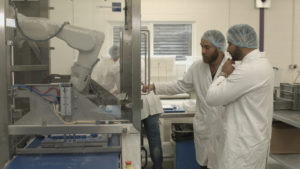
I don’t know of any UK manufacturers who are consciously adapting their processes to fit within the Industry 4.0 concept, but many are moving in this direction. For example, personalised confectionery manufacturer Boomf enables its customers to print their choice of photos, graphics and messages on to marshmallows through designing the template and ordering them online – a very Industry 4.0 idea.
Within a year the product proved so popular that Boomf had to automate its manual cutting process to reduce the cycle time from five minutes to 17 seconds. Additional benefits include increased flexibility; Boomf can now easily respond to changes in seasonal demand.
Perhaps Boomf isn’t consciously implementing a smart factory approach but installing robot automation on the shop floor is certainly a smart start for any manufacturer that wants to remain future-proof.
Q) So how exactly do robots figure within the Industry 4.0 model?
Industry 4.0 is a model which incorporates a number of different automated machines operated via the ‘digital thread’ – an industrial Ethernet system that sends data back and forth to a centralised computer system where all processing information for a factory can be recorded, monitored and actioned.
As cyber-physical systems which use data in the form of programming languages to operate, robots are one of the most prevalently featured automated machines in any smart factory plan.

Q) Many manufacturers worry that robot maintenance is too complex and time-consuming. How would this work in the context of Industry 4.0?
Industry 4.0 is based on interconnectedness. The data which is collected and transmitted from machine to machine can then be used to inform maintenance. Rather than an engineer having to complete checks according to a schedule, data can inform when a problem is likely to occur long before it does.
Such an approach has been coined predictive maintenance (PdM). Our own approach, Connected Services, includes immediate critical alarm notifications via email or SMS so that maintenance engineers can be remotely informed about the robot’s performance. They can also rectify the problem simply by logging in via a computer or smart device
Q) What does a manufacturer need to consider before implementing robot automation in preparation for industry 4.0?
UK manufacturers should firstly consider whether there are any processes which could be automated now. Finding repeatable tasks that could be performed by robots instead of people for example can enable you to get more out of your staff by assigning them to handle more rewarding and higher-value tasks.
It’s also worth considering the growing demands of customers. For example, will they expect variations in your current product, or even products which are customised to serve individual needs or tastes? Robots can provide the flexibility to meet these demands, both now and into the future.
If you’d like to find out more about whether robot automation could benefit your business, visit our Switch to Robots page at http://bit.ly/SwitchtoRobots. Alternatively, email robotics.gb.abb.com or call 01908 350 300 quoting ‘Switch to Robots’.
Michelle Jocelyn
Marketing Manager
ABB Robotics Limited
Auriga House
Precedent Drive
Rooksley
Milton Keynes
MK13 8PQ
Tel: 01908 350 300
Email: robotics@gb.abb.com
