
 Established in 2020, Wavecon Ltd is a Hartlepool-based provider of cable assembly solutions for subsea assemblies. The company offers a range of services, from the supply of replacement cable harnesses and wired assemblies, through to fully designed and manufactured bespoke assemblies for specific applications.
From the outset, the team decided to build an end-to-end manufacturing process to retain 100% control over product quality. By investing in high quality equipment, machinery and tooling, the team could ensure all manufactured parts meet its exacting quality standards.
Wavecon offers a bespoke and original equipment manufacturer (OEM) range of encapsulation and moulding solutions, supported by an integrated 3D CAD and CAM, 3D prototyping, and CNC services. As part of this, Wavecon applies a variety of overmoulding techniques, including two-part moulding and low-pressure vertical injection moulding.
Building an overmoulding process
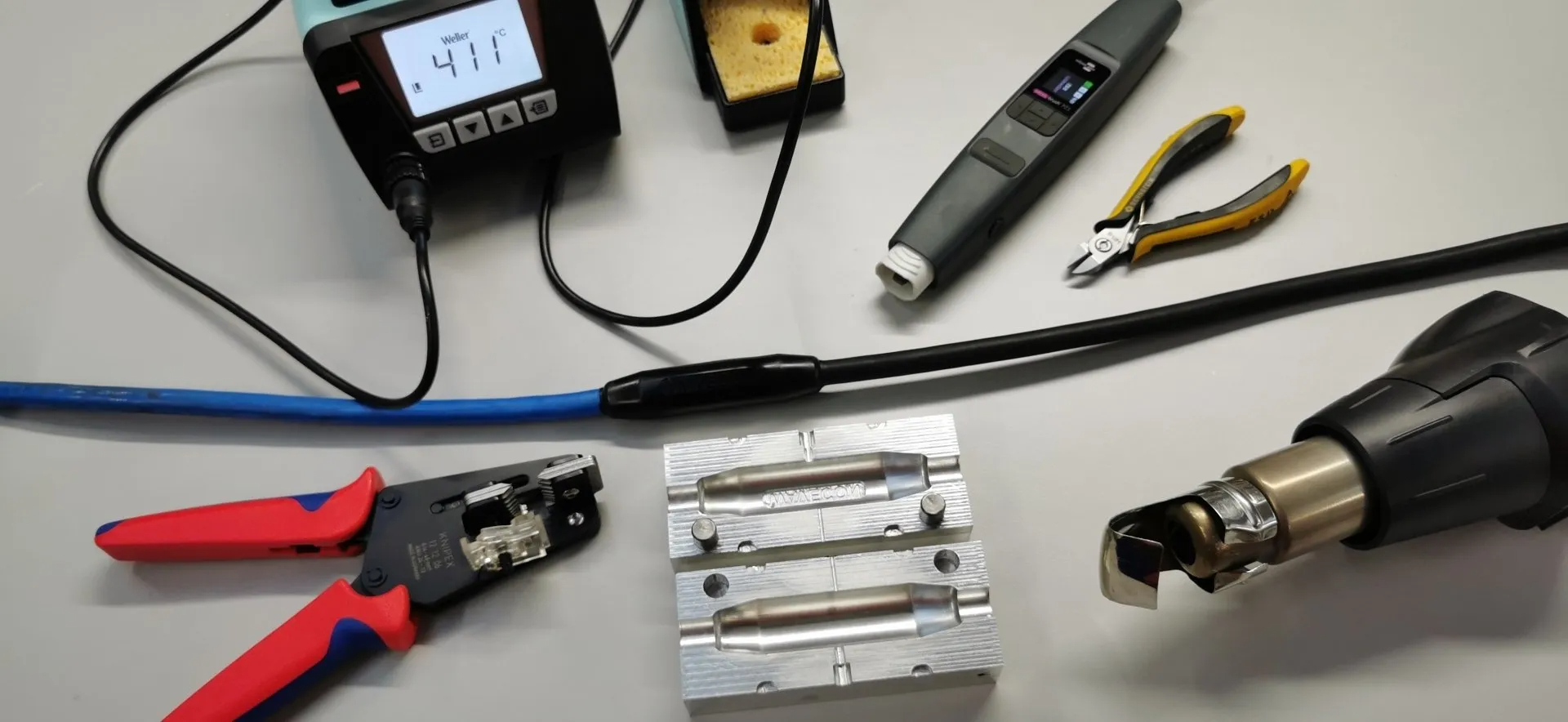
Overmoulding is used to form a watertight and strong mechanical seal around cable assemblies used in harsh environments, particularly sub-sea applications. The cable assembly is positioned within a mould and the overmoulding material is injected into the cavity. It is important that the moulding material adheres well to the surfaces providing good shear and peal strength to cope with any movement.
Wavecon’s overmoulding process involves bonding to a range of different materials, dependent on the customer’s application. A wide variety of materials are used in the subsea cable market, including insulation made from polyethylene, chlorinated polyethylene (CPE), polyurethane, rubbers, and neoprene, many of which have low surface energies resulting in poor wettability and bonding. These substrates present an adhesion challenge.
Initially the company took steps to improve adhesion by abrading, and painting the surfaces with liquid primers, which are active chemicals in a solvent carrier. However, the use of primers introduced some issues, such as the wait time for the primer solvents to evaporate, which is further increased when repriming is needed.
In addition, because the company works with so many materials both for the cabling and the overmould, there were a lot of process variables, and the team experienced inconsistent results.
Finding a solution
Wavecon was looking for a way to optimise the adhesion of the overmoulding material to the cable sheath to achieve a good bond strength and perfect the process.
Paul Whitehead, strategic accounts manager at Intertronics, said: “After detailed discussions with Wavecon’s team, we recommended the piezobrush PZ3 handheld plasma surface treatment device to treat the outside of the cable before it is inserted into the mould. The device increases the surface energy of the substrate, by altering the chemical groups on the surface to improve wettability and create bonding anchors on the surface.”
The Piezobrush PZ3 uses cold atmospheric plasma technology and therefore does not involve significant heat. The handheld device uses piezoelectric direct discharge (PDD) technology to transform low input voltage into high electric field strengths, dissociating and ionizing the ambient gas (usually air) into plasma.
Where conventional atmospheric pressure plasma treatment processes may require special gases or automated handling, the PZ3 is unique in that it is a handheld cold plasma device, enabling uncomplicated and manual optimisation of surfaces at a relatively low cost, on demand.
The PZ3 requires no specialist knowledge to operate and is equipped with several in-built process control features that can be adjusted using a simple user interface, so Wavecon could easily tailor it to different applications.
David Stout, director at Wavecon, said: “After speaking to Paul at Intertronics, learning about the available options from its whitepapers and hearing about Intertronics’ experience with past applications using the PZ3, we decided to trial it in several applications. We did consider alternative plasma technologies, such as large ovens, but decided that the PZ3 would be easier to use, was more affordable, and would deliver quicker return on investment.
“We conducted extensive trials with different primers, different surface finishes, and with plasma pre-treatment and got good results bonding the polyurethane to rubber and polyurethane CPE cabling. We found that by abrading the surface and then treating with the piezobrush plasma pen, we could encapsulate the cables with a good, watertight join.”
The Wavecon team has since done extensive testing in a pressure chamber at 466 bar, the equivalent of 3000 metres deep, demonstrating high quality and excellent durability.
A quality process for quality products
With the introduction of the PZ3, Wavecon was able to stop using primers in several applications. This means the team now uses fewer chemicals, which is better for operators, reduces the health and safety requirements for respiratory equipment, decreases risk, and is better for the environment. In addition, the PZ3 has helped Wavecon to decrease production time, as it has removed the wait time for primers to dry, as well as the need for repriming.
David Stout, director at Wavecon, said: “The PZ3 can do in five seconds what would previously have taken up to half an hour, further reducing lead times for our customers. We pride ourselves on quality, and the PZ3 has helped us to develop a reliable process that delivers quality every time.”
Wavecon delivered its first product in January 2021 and is now growing rapidly. In the next few years, the company is looking to hire new staff and develop new product ranges to continue its growth.
