

JC-Electronics explains the top sustainability benefits of refurbished industrial electronics
JC-Electronics sets out to measure the actual sustainability benefits of refurbished industrial electronics
Companies are now discovering the benefits of using refurbished industrial electronics. In addition to the economic advantages, they are increasingly recognising the benefits in terms of quality. Alongside this, there is the potential to achieve a more sustainable business process. But what is the real gain in sustainability? And how can it be made visible?
With help from Micha Klaarenbeek, managing partner and lead impact analyst at Ecoras, JC-Electronics, supplier of refurbished industrial electronics, dismantled a Human Machine Interface (HMI) to find out.
The transition towards circularity
Increasingly, companies want to move away from the linear economic model of take-make-waste. There is growing awareness that transitioning to a circular economy is essential to prevent the depletion of critical raw materials and reduce environmental pollution. Using refurbished electronics contributes greatly to this shift by lowering demand for virgin materials and reducing e-waste significantly.
This reduction is needed urgently. Improperly separated or collected e-waste can cause serious problems in municipal waste streams, for example, when lithium-ion batteries catch fire or explode during processing.
Refurbishment also helps conserve critical raw materials such as lithium, copper, and gold. Additionally, it reduces the use of water and toxic chemicals and lowers the carbon burden on the environment. The reduction in CO2 emissions from using refurbished industrial electronics can easily reach fifty per cent, and in some cases up to ninety per cent.
Calculating the environmental impact
These percentages are certainly impressive. However, it is no small thing for a company to switch to refurbished products, so before making the decision, they will want precise data about the reduction in CO2 emissions for their specific devices.
To obtain such data, the environmental impact of each individual component must be calculated, which is why, with Micha Klaarenbeek at Ecoras, JC-Electronics decided to disassemble a medium-sized HMI. In a room equipped with desks featuring measuring devices, soldering irons, and automatic screwdrivers, Micha spent three hours dismantling the HMI. It was a fiddly task, as it comprised numerous separable parts such as connectors and chips, and every single component had to be categorised. But this enabled JC-Electronics to carry out a lifecycle assessment (LCA) to determine its environmental impact.
JC-Electronics wanted to understand the environmental impact of an average HMI that it refurbishes. What are the material savings? What is the reduction in CO2 emissions for a refurbished HMI compared to a new unit?
Lifecycle assessment
To conduct a thorough assessment, a digital twin of the device’s lifecycle was created. The raw materials and energy required to manufacture each component and assemble the product were then analysed. Auxiliary materials (such as chemicals and water) used in both production and refurbishing processes were also factored in. Finally, the packaging, transport, and energy requirements in the end-of-life phase were calculated.
By adding all material and energy inputs and outputs, a complete picture of the resources consumed, including energy, water, and minerals was generated, and translated into the overall environmental impact across the product’s lifecycle.
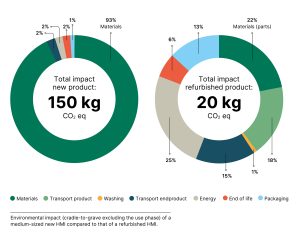
During refurbishment, certain components are replaced because they are faulty, prone to wear and tear, or susceptible to defects. The pie chart at the beginning of the article shows the environmental impact of an average, refurbished, medium-sized HMI. For this device, the emissions linked to raw material extraction and energy use are reduced significantly, making other environmental impacts more prominent by comparison. Nonetheless, the overall climate impact, expressed in CO2 equivalents, reduced by 87 per cent, to around 20kg of CO2.
The need for component-level care
It is one thing to understand the benefits, in environmental and quality terms, of refurbished equipment, but another to know how to choose the right supplier for your requirements. Many of the clues you need will be in the level of detail the refurbisher works to, focusing on individual components as well as systems.
You will want to ensure that your supplier undertakes a comprehensive assessment to ensure that only components that can be genuinely restored to a like-new condition proceed to the next phase, and that it cleans each individual component while ensuring safety throughout the process with electrostatic discharge protection.
Professional refurbishers also replace wear-prone components before they stop working. They should identify problematic parts like capacitors, relays, and cooling fans based on component age and failure data analysis and have the expertise to address component-level failures as well as software corruption and other issues.
Further questions to ask
In addition, never accept products that have not been tested properly. Any supplier you select should implement multi-stage testing protocols that verify functionality under various operating conditions, simulating real-world applications.
Your refurbished part needs to offer reliable service, regardless of operating conditions, so it is imperative that the components you buy have been subjected to environmental testing, including temperature and humidity extremes and vibration stress. Also essential is burn-in testing, which identifies early failure modes before delivery, and functional testing, which confirms proper operation across all features and modes.
Finally, warranty returns are inconvenient at best, very costly at worst, so be sure to choose a refurbisher that offers warranties matching or exceeding new equipment terms. This will provide reassurance that the refurbishment process is rigorous, and when backed with certifications like RecQ, you are assured of objective validation of refurbishment standards.
The numbers say it all: the environmental case for using refurbished industrial electronics is strong. With clear data now available through lifecycle assessments, companies have the evidence they need to confidently choose more sustainable alternatives and make a measurable difference.
