
Kitronik is pleased to announce that its latest products to support the use of the BBC micro:bit are now available, along with on-line learning resources for students, teachers and makers.
As one of the of the original partner organisations collaborating with the BBC to develop the micro:bit project and as a distribution partner for the micro:bit Educational Foundation, Kitronik a leading developer of electronics project kits and learning resources for schools, makers and coders is on a mission to create products and resources to ensure users realise the full potential of the device.
These latest additions to their product range, The :KLEF Piano, The Robotics Board and the Create Board are the next stage in Kitronik’s ongoing mission.
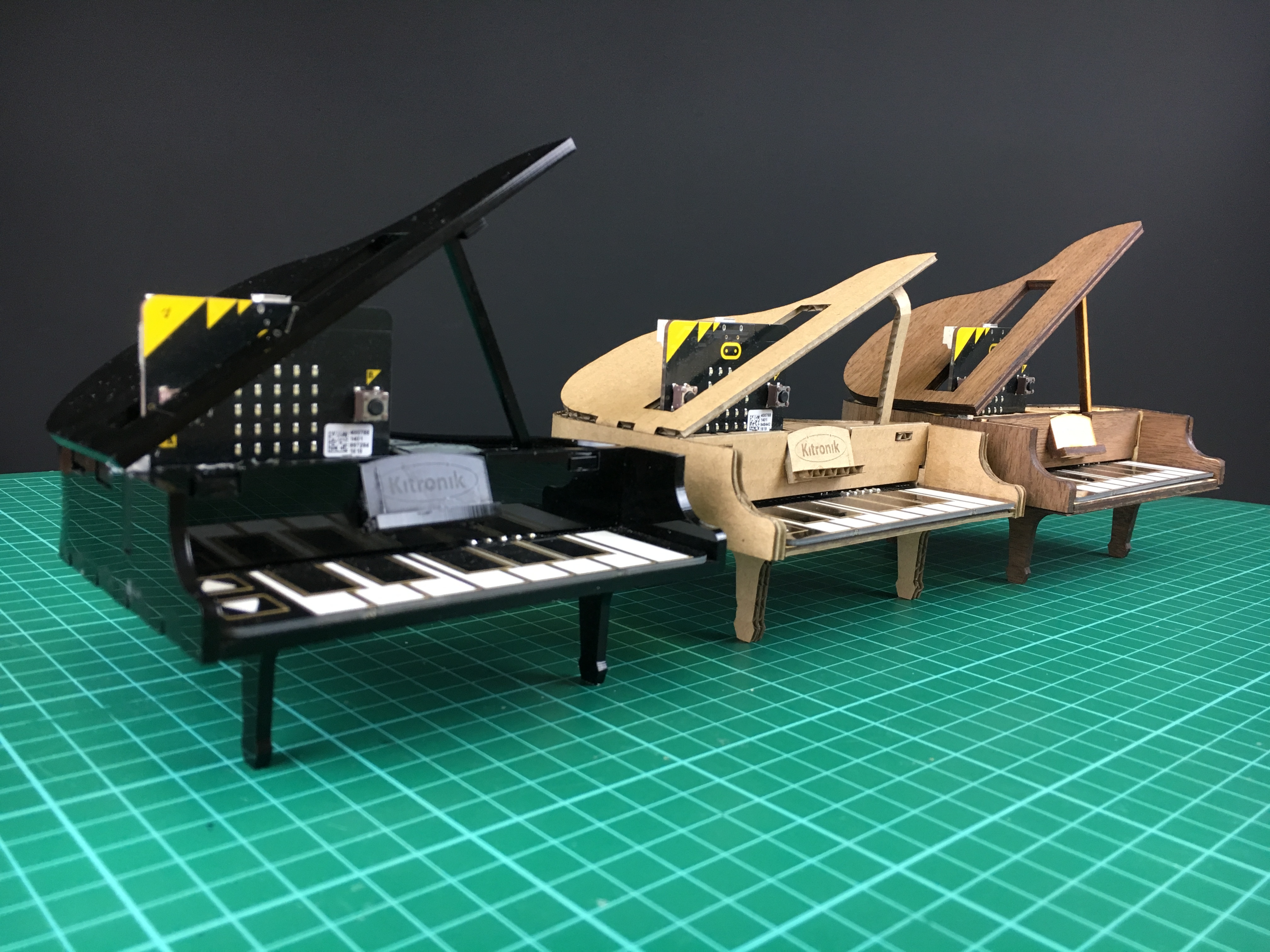 Hitting the Right Note with The :KLEF Piano
Designed to combine musical and digital creativity by enabling students and makers to create music using the micro:bit, the :KLEF Piano is a capacitive touch keyboard which features a full octave piano keyboard, amplifier and speaker and on-board edge connector.
The :KLEF features 15 capacitive touch pads, with 13 arranged as a single octave and 2 up down function buttons that allow the ‘pianist’ to change octaves. To use the :KLEF, the micro:bit is inserted into the edge connector and power is provided via a 5V micro USB connector. This then produces a regulated 3.3V supply which is fed to the connected BBC micro:bit, meaning that there is no need to power the micro:bit separately.
Expected to be popular with Kitronik’s global education customer base, the :KLEF allows students to learn coding and explore music at the same time. Code can be created using the MakeCode, MicroPython and Mu editors and the device can also be used to send data to other micro:bits, enabling it to control other buggies and robots.
As a finishing touch, Kitronik has made available free on-line templates for grand piano cases so users can showcase and use their :KLEF Piano. The cases can be made from wood, acrylic or card and cut by hand or with a laser cutter meaning the device can be used as a project for use across STEM subject areas. Please click here to view the resources on the Kitronik website.
Kitronik co-founder and director Kevin Spurr comments: “It has often been said that there are many similarities between being able to code and being able to read music and we have designed the :KLEF to offer a fun introduction to combining digital and musical skills. The device can be used across STEM subject areas and demonstrates the capabilities of the micro:bit to really capture the imaginations of students and young makers.”
For further detail on the :KLEF, please click here to view the latest video on YouTube.
The all-in-one robotics board for the BBC Micro:bit
The potential to expand the use of the micro:bit and its ability to control other devices is one of the reasons for its popularity. To support this, Kitronik has launched its ‘All-in-One Robotics Board’ for the micro:bit, allowing users to control motors, servos and processes.
The Robotics Board enables the micro:bit, when connected via standard card slot connector, to drive 4 motors (or 2 stepper motors) and 8 servos. Coupled with 17 other I/O expansion points, this means the BBC micro:bit can very easily become the core of a whole variety of robotics projects.
The :CREATE Proto Board
For makers looking to create prototype circuits using the BBC micro:bit, Kitronik has created the :CREATE Proto Board.
The board has been carefully designed to allow the use of a mixture of surface mount and conventional components. The prototyping board area is based on two grids. The through holes are on a 2.54mm (0.1”) pitch grid and the surface mount pads on a 1.27mm (0.05”) pitch grid. These grid sizes are designed for most common components to fit. The surface mount pads are also designed to be linked with solder so small tracks can be made. All BBC micro:bit pins are available to connect to the prototype area.
Kevin Spurr adds: “Our latest products are designed to test the potential of the BBC micro:bit and encourage its use as the focal point for a range of projects both inside and outside of the classroom. I am looking forward to seeing the projects created by our customers and I encourage them to share them with us on social media.”
