

MIL-STD-461G EMI test failures drive demand for retrofit filter solutions
Avoiding redesigns after EMI compliance failures cuts time and cost
Electronic equipment that fails MIL-STD-461G electromagnetic interference (EMI) testing often faces costly redesign work, extended certification schedules and delayed production programmes. According to Quell, its EESeal EMI filter inserts provide an alternative route to compliance by targeting emissions and susceptibility issues without requiring board-level redesigns or connector replacement.
MIL-STD-461G remains one of the most demanding EMC standards used across defence and aerospace programmes. The specification is intended to ensure electronic systems continue operating reliably in harsh electromagnetic environments where interference can affect system performance, safety and operational availability.
When a prototype fails qualification testing, the conventional response often involves redesigning circuit boards, modifying shielding arrangements or reworking grounding strategies. Those changes can introduce new engineering cycles, increase validation costs and create uncertainty around certification timelines.
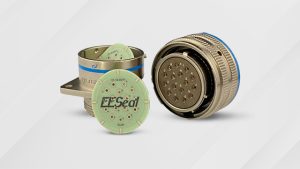
Quell’s EESeal inserts are designed to address EMI issues at the connector interface. The company states that the silicone-based inserts contain miniaturised filtering electronics and can be installed directly over connector pins without soldering or mechanical modification.
According to Quell, custom filter inserts can be delivered within 24–48 hours, allowing corrective action to be taken rapidly during qualification programmes. The company describes the inserts as a solution that can be installed “right at the test centre”, reducing the time between failure analysis and retesting.
Connector-Level EMI Mitigation Targets Problem Frequencies
A key characteristic of the EESeal approach is the ability to tailor filtering performance to frequencies identified during compliance testing.
Quell reports that the inserts are engineered to attenuate both conducted and radiated emissions across a broad frequency range while also improving immunity to external interference. The company notes that filter characteristics can be customised to address specific frequencies responsible for test failures.
One example cited by Quell involved a military communications system that failed radiated emissions testing between 100MHz and 1GHz. By applying EESeal inserts configured for those frequencies, the system achieved compliance without requiring modifications to the electronics design.
The company describes the inserts as offering “superior EMI suppression” while providing “enhanced susceptibility protection” against external electromagnetic threats.
Production and Qualification Schedule Benefits
Beyond technical performance, the commercial impact centres on programme timing and cost containment.
Connector-level filtering can eliminate the need for board respins, shielding redesigns and associated requalification activity. Quell positions the technology as a permanent production solution rather than a temporary test fix, with suitability for defence and aerospace deployments where long-term reliability is required.
The company also highlights compatibility with standard connectors and installation procedures that require no tools. Quell states the inserts can be integrated without redesign activity, describing them as a “plug-and-play design”.
Addressing Common MIL-STD-461G Failure Mechanisms
The company identifies cable-induced interference as one of the most common causes of EMI test failures. Cables can act as antennas, either radiating unwanted emissions or coupling external noise into equipment.
Grounding and bonding deficiencies are another frequent source of compliance issues. Quell states that its filtering approach can improve grounding effectiveness and reduce problems associated with ground loops.
As defence and aerospace programmes continue to face pressure to control development costs and maintain qualification schedules, retrofit EMI mitigation technologies are becoming an increasingly practical option when certification testing uncovers unexpected interference problems. According to Quell, EESeal inserts provide a route to compliance that can be implemented rapidly, helping prevent EMI failures from escalating into wider programme delays.
Damian Semple, franchise marketing manager, commented: “Failures discovered during EMC qualification can have a disproportionate impact on programme schedules because redesign activity often affects multiple parts of the validation process. Technologies that can be deployed quickly and without hardware redesign provide another option for managing certification risk, lead times and engineering costs.”
View Quell’s product portfolio
For more news please visit: News – CIE
